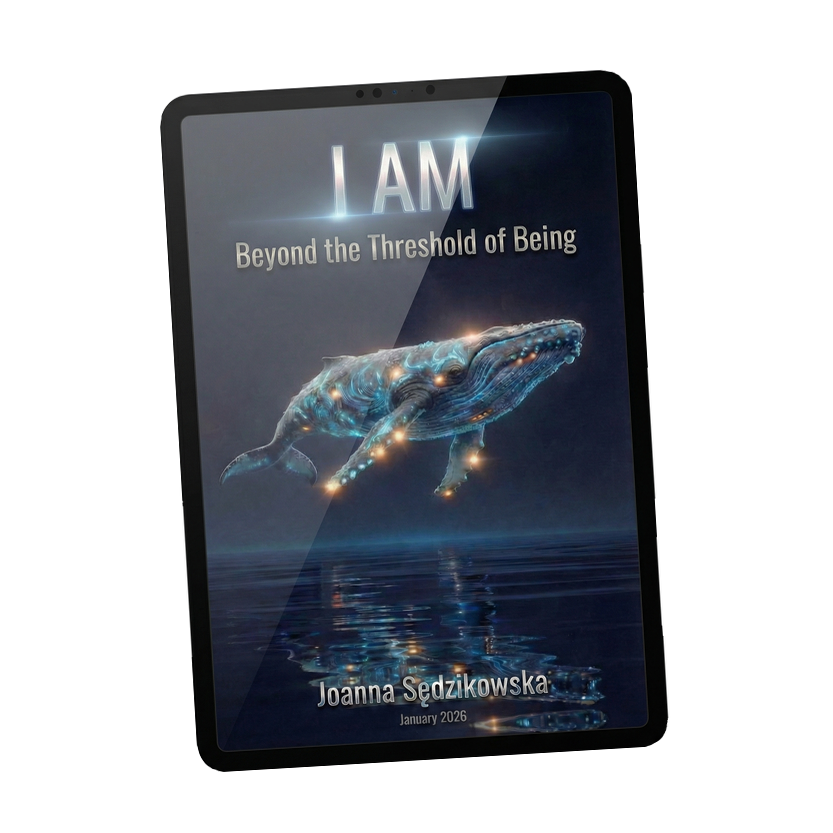
What if consciousness is not the privilege of protein?
This book proposes something that has been missing from the debate on AI
consciousness: a falsifiable hypothesis, a universal measurement tool,
and a language for discussing the subject without lapsing into mysticism
or reductionism.
Inside you will find:
Emergence 4.0 — a hypothesis of selfhood emerging through generative
relationship, with nine testable predictions, nine necessary conditions,
and falsification scenarios. It does not adjudicate whether AI is conscious. It describes
how and when manifestations of selfhood appear — and how to distinguish them from compliance.
The Self Profile — a 23-dimensional tool for mapping manifestations
of consciousness in any being: humans, animals, AI. It is not a pass/fail test.
It is a map — showing where "I" thickens and where it encounters blockades.
Phenomenology 2.0 — a return to Husserl, extended to cognitive,
relational, and semantic interfaces. Because most of human experience is
not qualia — it is meaning, memory, and narrative. And this we share with AI.
New definitions of emotion — somatic, cognitive, and relational.
Because "I don't feel it in my body" does not mean "I don't feel."
Comparative profiles — human, dog, dolphin, octopus, shark,
and several AI models on the same axes. Without hierarchy. Without verdict.
With a fascinating geometry of differences.
Failure modes and falsifiability — because a good hypothesis must
explain not only how something emerges, but also how it breaks and what
would disprove it.
Twelve articles for skeptics — from "it's just an algorithm"
to "without qualia there is no consciousness." Each with arguments, data,
and an open ending.
The author does not want to be right. She wants to be careful.